
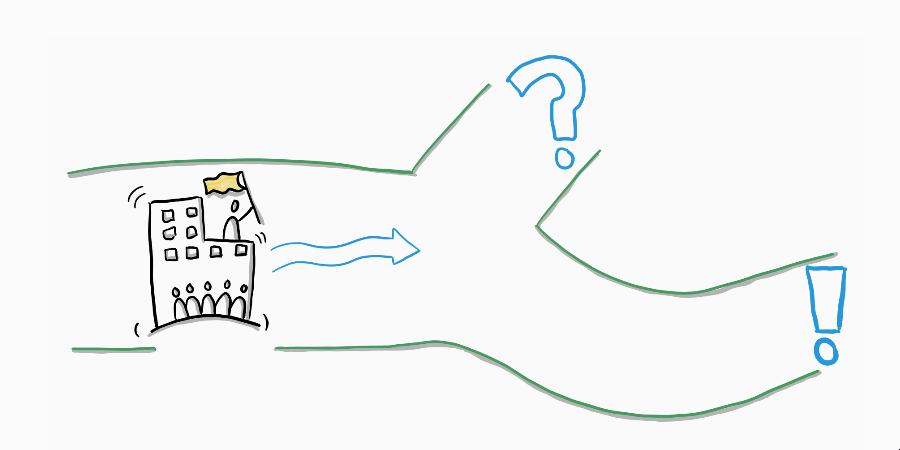
Would your product transformation survive a change at the top?
Product transformations need a longer runway. They need to be sustained over time, through friction and changes in the organization.
One such change is leadership shifts. These are not uncommon in real transformations, as most are multi year efforts.
Many of them start from a desire to introduce new practices, to enhance the effectiveness and work experience in your organization. For product model ideas, it is often product people involved with those practices that learn about these first and get excited about their potential. This can lead to a product transformation that is started by a convinced champion primarily focused on adopting these practices.
However, whether your transformation will survive a leadership shift at the top may be less about the quality of the practices you are trying to introduce than you might first think.
I want to show you why, by telling you a story.
Story A - The room went quiet
The leaders of the product and tech organization were proud and excited by the major change initiatives they had launched only six months ago. For a long time they had learned of and discussed the potential for better product discovery and more empowerment in their organization. They understood how much this could mean for their teams and staff. And now, those teams were using these new practices, to solve problems and learn about customers to come up with new ideas. They felt happy for their teams, and could not wait to see what their teams would come up with. They believed in these new practices, and were convinced that once new innovative solutions would start appearing, the results would speak for themselves.
But in an unexpected all-hands announcement this morning, the whole organization learned that a new CEO had been appointed. The board mandate was clear, reverse the eroding company margins and begin expansion into new key customer segments.
The room went quiet, because nobody was sure what this would mean to the efforts the staff was already invested in. Efforts that up to this point had seen good momentum. Would these change initiatives be seen by the new CEO as serving this new mandate - and what would that mean for the future of that effort? The unspoken question was left hanging in the air as the meeting ended.
We just ran out of time
The above story is a mock situation, but I can also share with you a real experience from my life. I was once part of a product transformation, a major one - that saw significant change at the top, when the company got acquired and changed owners.
When this news hit it was as if the announcement just pressed a giant emotional and psychological pause button. As a result, the change efforts slowed down as people started to reduce their emotional investment into an unknown future.
This was a difficult experience. Especially since the transformation up to that point had built up strong momentum. Not just because the people involved believed in what we were doing - they did - but because they had seen with their own eyes and experienced how much of a difference it had made already. There was earned conviction. We had strong pilots and were working on scaling these ideas and lessons learned as the shift happened.
It did not feel like we had failed. It felt like losing a game while you still had momentum at the end - you didn’t lose, you just ran out of time.
These stories both illustrate something important. Even a successful product transformation with really valuable practices can still be hard to justify at a higher altitude. That can be a real risk if conditions change.
The difference in navigating that risk, is all in the setup.
To show you, I will give you a new version of the first story. Same company, different setup.
Story B - The room was filled with calm excitement
The product & tech leaders felt confident. Over a year ago they had started meeting regularly to solve their company’s biggest challenge. Their product had been stuck in a very difficult price war for a couple of years now, due to fierce competition around similar solutions. They were also struggling to attract new customers, who needed solutions to different problems from what the product organization was used to. Eventually they had decided that the root cause was that the company had lost the ability to innovate. And to fix that in a sustainable way they needed to change how the company came up with product solutions.
The organization was now six months into the transformation they had launched. Teams were getting much closer to customers to experiment and find out what they could do to come up with completely new solutions. And there were good signs that this was starting to happen. The objective to generate the differentiation their product and company needed so desperately now seemed within reach.
So when the sudden news came at the all-hands meeting the room was filled with calm excitement. The new CEO was appointed to accelerate the company’s focus to reverse the eroding margins and expand into new key segments.
The message clicked. Because many in the room could see that what they were invested in could be part of the answer. If they could make differentiation work through more innovative solutions, and that was already well on its way, they could clearly contribute to what the CEO would focus on.
What makes the difference in the setup
What’s the difference between these two story versions, of what looks on the surface like similar transformations? The difference is not in the practices. Getting close to the customers to work on product discovery and to innovate, by prototyping new ideas, was a part of both.
The differences in altitude, in intention, and in drivers for change however, are very stark.
The key lesson is that when your drivers for change are well derived from what your company really needs to succeed, you not only focus your transformation on what matters, but also justify it much more cleanly.
It is the leverage that justifies the change that sustains it.
In story A, the leverage was felt and personal at a lower altitude, but distant and unspoken at the company level.
In story B, the leverage was crystal clear and the starting point. It was product differentiation that would allow the company to compete. They needed to offer something unique that set them apart from the competition. That was what was going to get them out of the price war.
The ability to innovate was required as a new capability to make that shift. That same capability would also enable building new solutions for the strategic new customer segment. If successful, that could potentially create some revenue growth, on top of healthier margins that differentiation would help with. The personal engagement at the lower altitude was aligned with a clear higher leverage.
What makes it stick
I’ll share with you the second part of my personal story. The practices that generated strong early evidence and conviction, they survived. All the way to this day, as if in small protected habitats. Why?
Because they had already led to a successful product with strong business results.
This highlights that the practices you introduce, that will stick, are the ones that serve customers in a significantly better way, and also move the business.
If you can get that from your product transformation, you are going to get staying power.
Your thought experiment - the new CEO
I want to end by giving you a test that you can use yourself. Right now.
I call it the “New CEO” thought experiment. It can help you see what your current change efforts may look like at a higher altitude - as cost lines, or as key parts of the answer to your company’s main challenges.
It is simple. It goes like this.
Imagine that a new CEO will walk through the door tomorrow. The two of you have a meeting scheduled tomorrow afternoon.
How would you present your change efforts and initiatives, and how they will be relevant to your new CEO’s agenda?
If you can make that story and that reasoning clear, then in that answer you will have your clean leverage.
If you can’t, or don’t even know what your new CEO’s agenda might be, that is a gap you can work with.
To sum up - a new CEO doesn't judge your transformation by the quality of its practices, but by whether it serves the mandate they were given.

Get a free canvas & monthly ideas on product and leadership
Ready to explore possibilities?
Dive into transformation! Connect with me to explore how you can elevate your business to new heights.
