
When your customer experience outgrows your decision-making

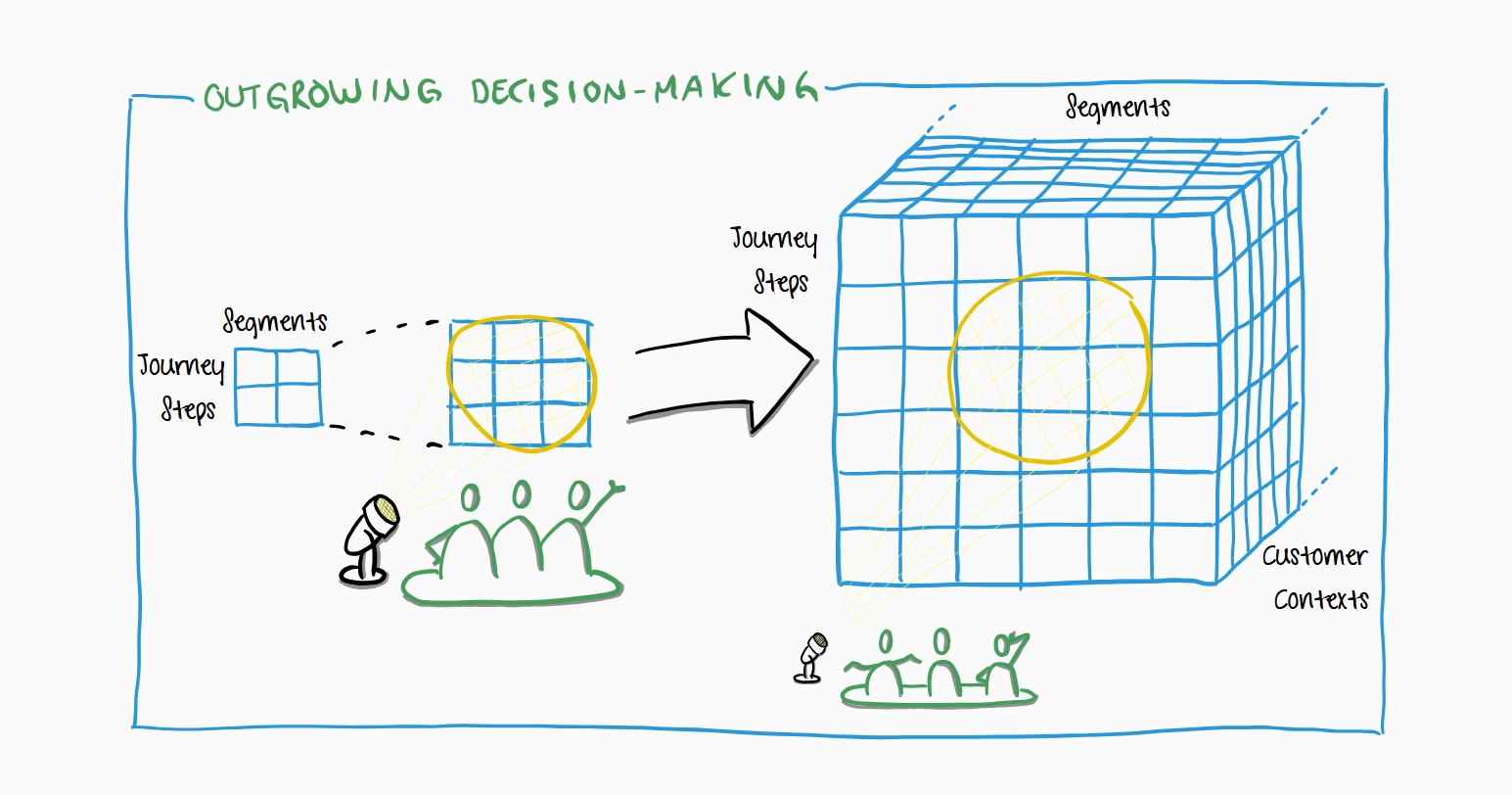
How success multiplies the product decisions that matter, and why only scaled decision-making can keep up
The future looked bright.
The fast growing B2B logistics product startup was now entering its fourth year. As the CEO looked back, she felt pride. Only two years ago, the first major product release centered on transportation orders had become a big hit. This had led to fast growth in their first segment, small local distribution centers.
The success in year two led to steady expansion in year three, as an additional segment, local logistics hubs, was targeted and additional steps in the customer journey around delivery confirmation was added.
By now she trusted her small product leadership team. It was dedicated and had proven capable of getting the product right. The team of three had intensified the work to understand the new segment deeper by spending time at the logistics center every Thursday, to come up with new smart solutions. They were clearly a strength to build around.
The above is a mock story based on a pattern that I have watched play out.
Why it still works
A core of product leaders make good decisions, close to customers, allowing the product to create early success. This leads to expansion into adjacent segments and new product support for additional steps. In this phase, scaling within a central paradigm still works well.
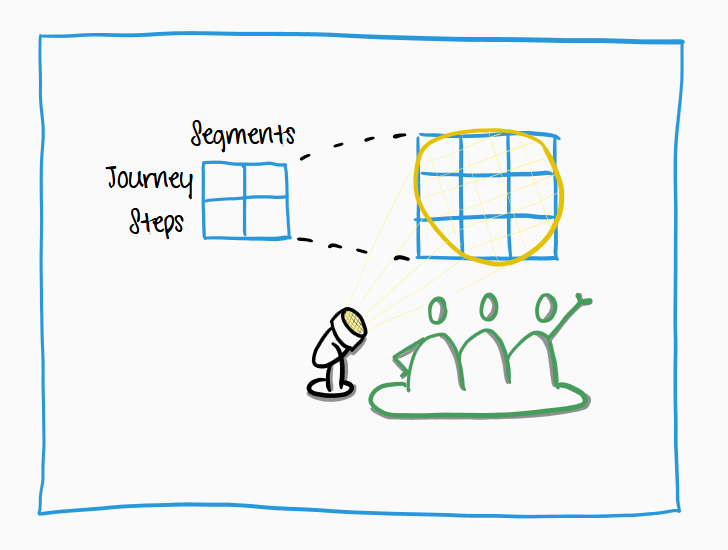
A good illustration and metaphor for this phase is a handful of combinations growing to a 3x3 checkerboard. The level of complexity grows but still stays bounded in just two dimensions and a low number of combinations. The small team of decision makers can still leverage their earned product judgement, as they both sense and solve for the nine fields of customer needs and solutions, to fit their product into all positions of the checkerboard.
But what happens as we play this scenario forward a bit more?
Year five, a lukewarm launch
The CEO was sitting alone in her office after the recent product update meeting, considering her options. The next board meeting was a month away, and she had not yet decided how she would express her assessment.
The fast growing startup was now in year five. After strong growth in year four, opportunities had expanded quickly. Ownership had been encouraged by the fast progress and decided the company would expand into a new segment, regional logistics centers near medium size cities.
To lead the now growing product organization, leaders had given more care to company roadmaps to make sure their teams could align on how the product needed to respond. In addition to the multiple segments, there was new planning and inventory support that many customers had asked for. This was assessed as especially important to the new regional customer segment. Preparing and managing the planning for all this and leading the work had meant leaders spent less time at the logistics center. But since they had come to know the customer businesses so well by now, that had felt like the appropriate tradeoff to support a fast growing company.
The major release had been delayed, but when it finally launched just before Christmas, the reception had been lukewarm - at best. It was still early, but indicators showed that adoption had been much slower than expected.
The CEO was not sure herself what the next step should be. Among her product leaders there seemed to be split ideas on the issue as well. Some were questioning the new segment timing as too early. Some wanted to spend much more time with their multiple teams, to get all the details right in the product. Some felt that the track record of success had proven that they were on the right track, and advocated patience for a longer runway so adoption could pick up and eventually generate stronger market penetration.
What was undeniably clear when looking at the financial numbers was that business growth had started to flatten out. And when it came to the new strategic market segment the company was betting on, results still looked weak. Customers still preferred older more specialized products that fit them better.
The next step for the company seemed uncertain.
The mechanism - a sensing and judgement bottleneck
As your product grows from success and the number of customers expands, the complexity of your customer experience multiplies. This happens naturally as the variability of each customer’s context increases and your product can do more.
The demand for your product is determined by how well your product fits all of those variable “nooks and crannies” of your growing customer experience.
A central decision-making approach gradually comes under increasing pressure, as the number of decisions that require judgement scales quickly. This leads to a bottleneck where the people who make these central decisions can no longer invest the same amount of time and care in how well the product fits to each such “nook and cranny”.
Only a shrinking proportion of decisions can stay high-touch.
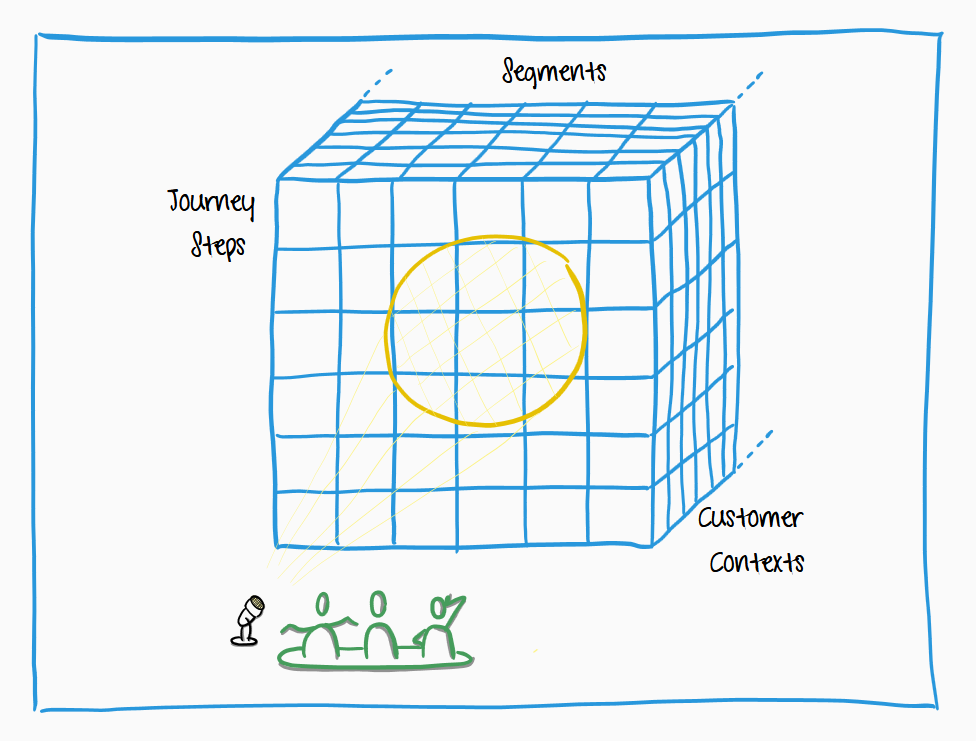
This can be illustrated with how what was a manageable 3x3 checkerboard morphs into a high resolution cube, with an exponentially growing number of combinations of customer expectations to solve for.
To deal with this, central decision makers often respond with new heuristics that allow them to adapt to the constraint of their own time. This is typically done by focusing on what they see as the big decisions. For everything else they start relying more on their product judgement and taste built up in previous phases, that they have come to trust.
Leaders start making decisions without sensing. As variability and complexity grow, over time decisions become less accurately tuned to market needs.
Hard to diagnose
This can be hard to diagnose in a central decision-making setup, because the need to both sense and to fit better exists before that gap is felt.
What leaders see and recognize first are often the lagging symptoms of the above mechanism: declining growth of the product, margins pressed by other products that are fitting better to local niches, a customer satisfaction trend that is declining, and so on.
A strong fit in a few niches becomes an average fit in many.
The reference points that these leaders have from their early successes do not help them either, because back then they were successful and were able to make good decisions.
As the story shows, leaders may first attribute the slowdown to other factors.
The key insights
The success of your product leads to an exponential growth in the number of product decisions that matter.
Every decision that matters needs its own coupled sensing. Sensing before the decision in the form of learning and sensing after the decision in the form of confirming that the decision was correct.
Sensing and local decisions that lead to good fit are what develop product judgement.
The central decision-making approach itself is what is blunting problem-solution fit. The few people making these many decisions do not have enough time to sense and evaluate all options of fit.
That matters, as your product needs a clearly better fit than your competitors to gain market share. Without it, a decline in product demand follows.
Scaling decision-making is the only way to sustain success for a complex product that solves for a diverse and complex customer journey.
The counter-example
One of the product teams I coached wanted to improve their customer experience. They wanted to know which of three friction points they should focus on in their small part of a much larger and complex customer journey. So they decided to meet with customers to find out. The answer? None of the above, as their interviews showed clearly that a fourth friction point stood out above the rest. They focused on resolving that first, and quickly improved the customer experience.
As the counter example shows, scaling decision-making at a high resolution is required to sense what to solve for, then make the right decision that gets the solution right. The decision the team made would not have happened without local sensing, and the solution could not have been created from a central position.
What you as a leader can do right now
Ask yourself the following questions:
- Who makes the product decisions that matter for your product? At what resolution do they typically operate? What sensing do they engage in before and after decisions to make sure they get each decision right?
Where your answers are the thinnest is likely where to start.
Summary
Scaling decision-making is a natural and necessary progression for a successful product that grows in complexity.
Product success itself multiplies the number of decisions that matter. Only scaled sensing and decision-making can keep up.
Our CEO in the story? One option she might consider: Ask her product leaders to help many more people do what they once did themselves - spend time at the logistics center. To learn, to make decisions, then confirm fit - to build the judgement her organization needs to scale decision-making.
Get a free canvas & monthly ideas on product and leadership
Ready to explore possibilities?
Dive into transformation! Connect with me to explore how you can elevate your business to new heights.
